PLMENOVIA3DEXPERIENCE
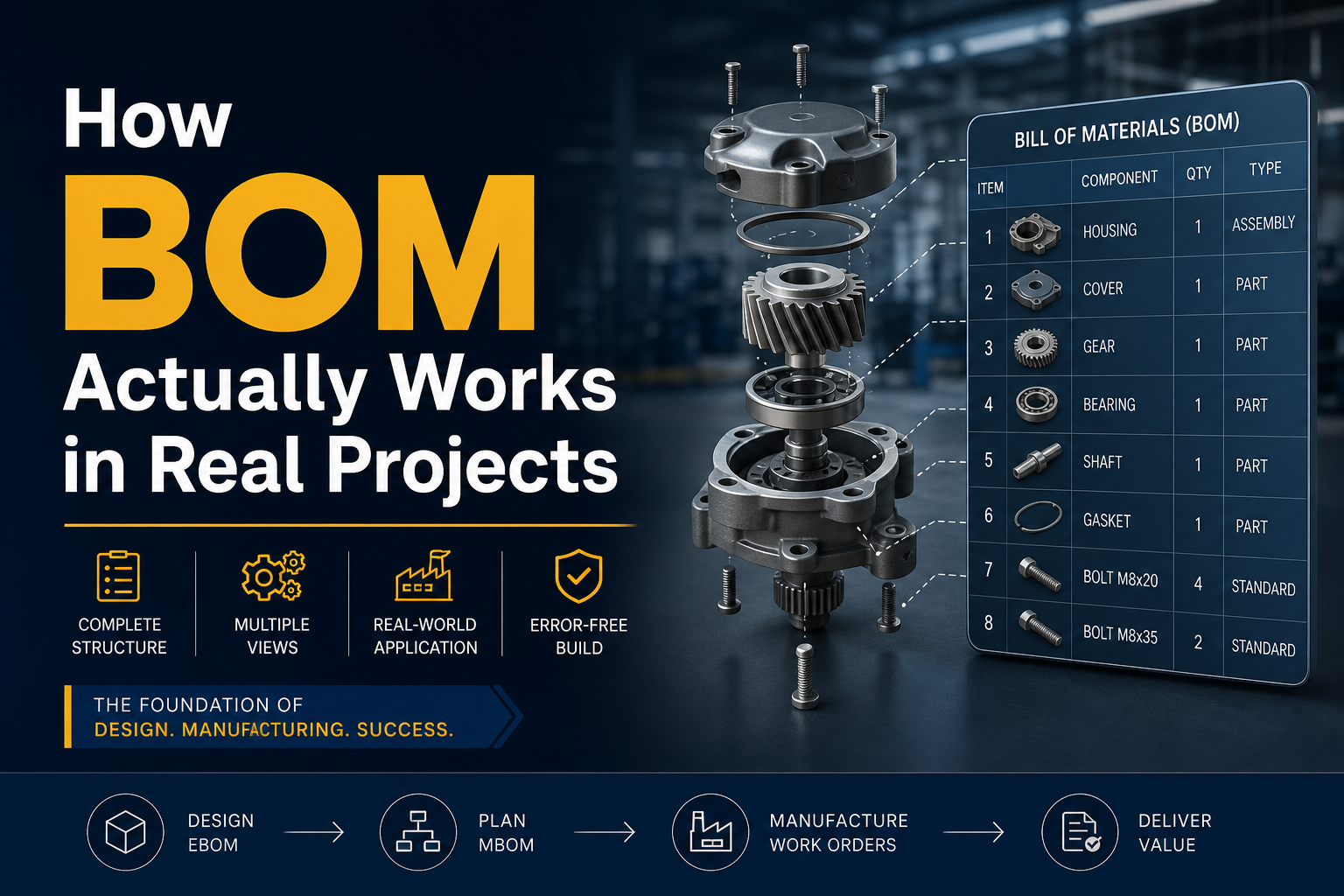
How BOM Actually Works
in Real Projects
Not the textbook version. The version where EBOMs get frozen mid-change, MBOMs lag behind ERP, and one quantity error shuts down a production line.
·May 3, 2026
·12 min read
·PLM · Manufacturing · ERP
A factory was ready. Workers at their stations. And production didn't start.
The reason: a component showed quantity "1" in the system. The actual build needed "4." One BOM error. One full day of production lost — plus the investigation, the rescheduling, and the supplier call explaining the delay.
This is what BOM management failure looks like in practice. Not a database crash. Not a software bug. Just a number that was wrong in a document that everyone trusted.
47%
Production delays traced to BOM errors
5×
Cost multiplier when errors reach factory floor
23
Silent BOM errors found in one mid-size factory audit
5
Types of BOM every team uses
What a BOM Actually Is
A Bill of Materials is the complete record of every component, subassembly, raw material, and instruction required to manufacture or deliver a product. That definition sounds straightforward. In practice, it isn't — because the same product generates multiple BOM views, each serving a different function, each owned by a different team, and each with the potential to drift out of sync with the others.
The BOM is not just a parts list. It's the operational backbone connecting design, manufacturing, procurement, finance, and service. If your BOM is wrong, every team downstream pays for it. The mistake almost always surfaces on the factory floor — not where it was originally made.
The 5 Types of BOM Every Team Uses
The same product generates multiple BOM views. Here's how a typical manufacturer uses all five:
EBOM
Design
Engineering BOM
Product structure as designed in CAD. Reflects how the product is conceived, structured by function — not how it's built.
MBOM
Production
Manufacturing BOM
Reorganized by assembly sequence. This is what the factory actually builds from — with routing steps, work centers, and labor time attached.
SBOM
Service
Service BOM
Defines spare parts and service procedures. Used by field service and aftermarket teams after product launch.
CBOM
Sales
Configurable BOM
Handles product variants and options. Critical for configure-to-order manufacturers where customer selections drive the build.
PBOM
Finance
Costing BOM
Used by finance and purchasing for cost roll-ups, landed cost calculation, and supplier contract negotiations.
🔑
One product, five views
Each BOM type serves a different audience. When any view drifts out of sync with the others, errors ripple through every team that depends on it. The challenge isn't creating any one of these — it's keeping them aligned as the product evolves.
The EBOM to MBOM Handoff — Where Most Projects Break
The transformation from Engineering BOM to Manufacturing BOM is the highest-risk handoff in product development. Design engineers structure a product by function — how it was conceived. The factory needs it structured by sequence — how it gets assembled. These are fundamentally different structures, and bridging them requires deliberate process, not assumption.
PLM / CAD
EBOM Created
Engineering hierarchy by function
→
Manufacturing Eng.
Sequence Restructured
Build order, assembly sequence
→
DELMIA / PLM
Routing Added
Work centers, tools, labor time
→
ERP
MBOM Received
Drives procurement & production orders
If the MBOM that reaches ERP is wrong — wrong quantities, wrong sequence, wrong revision — everything downstream is wrong. Procurement orders the wrong parts. Production starts on incorrect build instructions. Quality inspects against a superseded drawing. The factory finds out on the floor.
The 6 Most Common BOM Failure Modes
Incorrect quantities — the most common, and hardest to catch visually. A quantity of "1" that should be "4" passes every visual review.
Missing components — subassemblies or fasteners omitted during EBOM-to-MBOM conversion.
Wrong revision level — an obsolete part number still active in ERP after an ECO was applied in PLM.
Phantom assemblies — items in the BOM that are not physically procured or built as discrete units.
Unit-of-measure mismatches — PLM says "each", ERP says "per 100". The math works until it doesn't.
Change propagation failure — an ECO approved in
ENOVIA that never makes it into ERP. The systems hold different product definitions.
What Good BOM Governance Looks Like
High-performing manufacturing teams treat BOM management as a system, not a document workflow. The difference shows up in launch speed, rework rates, and how often the same root cause appears in quality investigations.
01
Clear Ownership at Every Level
Engineering owns the EBOM. Manufacturing Engineering owns the MBOM. Service owns the SBOM. Named owners, not shared responsibility. Grey zones in BOM ownership are where errors accumulate.
02
Automated Validation Before Release
Rules-based checks that catch quantity mismatches, missing references, and unit-of-measure conflicts before the BOM reaches production. Not after.
03
Cross-Functional BOM Review
Engineering and manufacturing engineering review together before release — not in silos, not sequentially. The person who finds the error in production should not be the first person from manufacturing to see the BOM.
04
Change Control With Downstream Impact Analysis
Every
engineering change order includes a review of what it affects in MBOM, ERP, and MES. The blast radius is mapped before approval, not discovered after implementation.
05
System-Wide Synchronization
Approved changes propagate automatically across PLM, ERP, and MES. No manual re-entry. No email notification as the only change mechanism.
The Three-Layer Software Stack
A BOM's accuracy is only as good as the systems that hold it — and how well those systems stay synchronized.
📋
PLM — Source of Truth for EBOM
Platforms like
ENOVIA, Teamcenter, and Windchill hold the engineering record. Change orders live here. Revisions are managed here. This is the authoritative source.
🏭
ERP — Drives Procurement & Production
SAP, Oracle, and similar platforms receive the MBOM and drive procurement planning, production scheduling, and cost accounting. They consume BOM data — they don't own it.
⚙️
MES — Shop Floor Execution
Manufacturing Execution Systems consume the production BOM in real time on the shop floor. When the BOM they receive is wrong, execution is wrong.
🔗
Integration Architecture
The key challenge: keeping PLM, ERP, and MES synchronized when an engineering change is approved. Most BOM disasters trace back to a change applied in one system and not propagated to the others.
Frequently Asked Questions
What is the difference between EBOM and MBOM?
The EBOM reflects how a product is designed — its functional hierarchy as built in CAD. The MBOM reflects how the product is actually assembled — reorganized by build sequence with routing steps, work centers, and labor information added. Both are derived from the same product, but serve entirely different audiences and systems.
Why do BOM errors happen so often?
BOM errors most often occur during system handoffs — when data moves from CAD to PLM, or from PLM to ERP. Different systems, different naming conventions, manual re-entry, and lack of automated validation all contribute. Without governance rules and cross-functional review, errors propagate silently until the factory floor catches them.
What does "single source of truth" actually mean for BOM?
Not one giant spreadsheet. One system of record — typically PLM — with governed, traceable handoffs to every downstream consumer. The EBOM lives in PLM. The MBOM is a configured transformation of it. ERP receives a governed handoff. Suppliers access a controlled portal. ECOs propagate through all affected systems as part of the change workflow.
What PLM systems are used for BOM management?
Common platforms include Dassault Systèmes
ENOVIA on
3DEXPERIENCE, Siemens Teamcenter, PTC Windchill, and Arena PLM. The right choice depends on your industry, existing tool ecosystem, and scale requirements.
🎯
The payoff of getting BOM right
A well-governed BOM creates a digital thread — one traceable version of truth from design to delivery. The companies that invest in BOM governance consistently see faster product launches, fewer production stoppages, lower rework costs, and stronger supplier relationships. BOM stops being a document. It becomes a system your entire operation trusts.
Written from hands-on PLM implementation experience across Transport & Mobility and Aerospace & Defence programs. Views are my own.