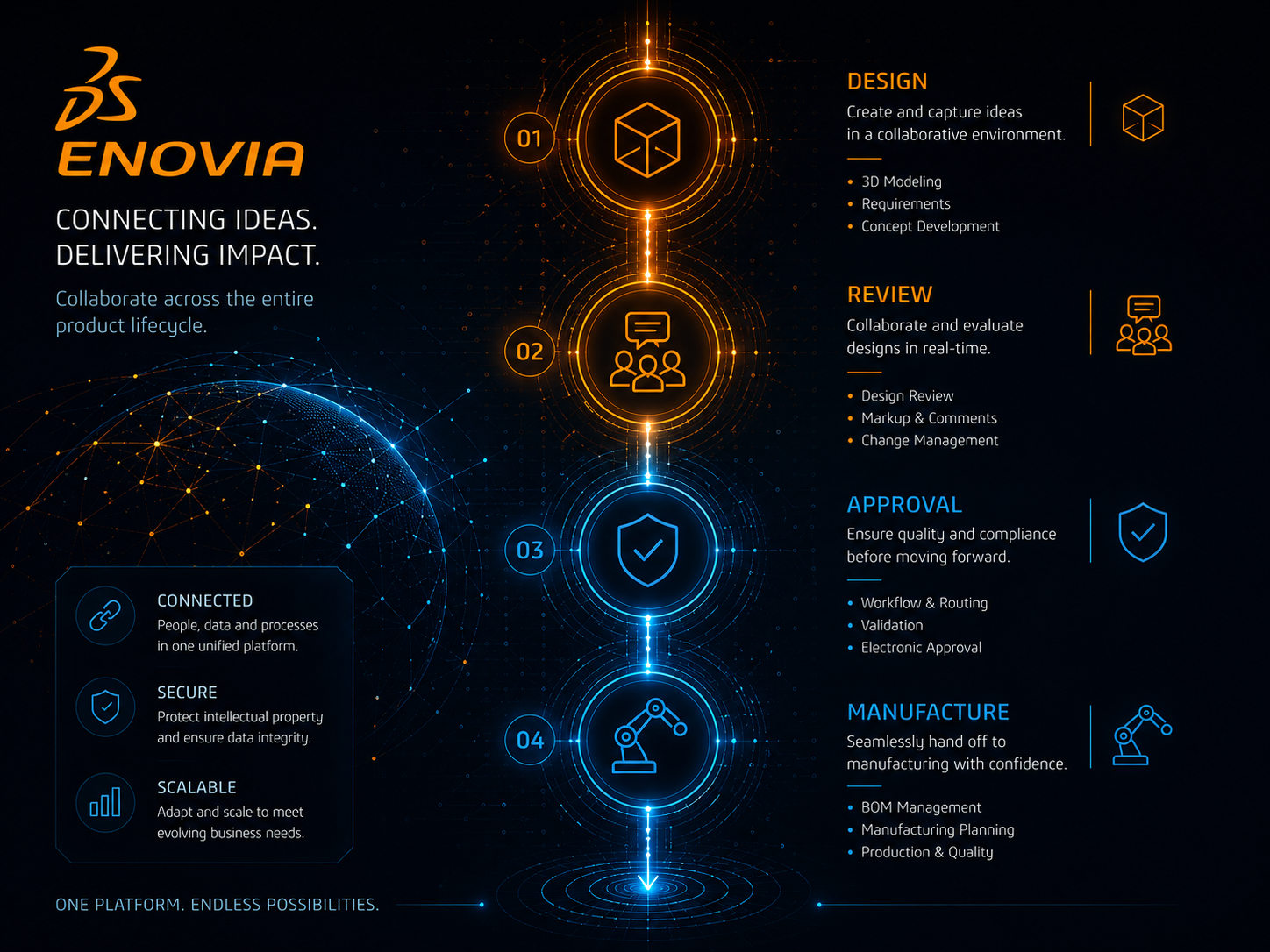
Engineering teams produce a lot of data. CAD files, drawings, BOMs, requirements documents, test reports, supplier specifications, change requests, meeting notes. Most of this data is connected — a drawing references a model, a BOM references a drawing, a change request references a BOM item — but in many organizations, those connections exist only in people's heads and manual tracking systems.
ENOVIA is the answer to this. It's Dassault Systèmes' product lifecycle management platform, and its job is to make those connections explicit, controlled, and accessible to everyone who needs them — throughout the product's entire lifecycle.
What ENOVIA Actually Manages
The core of ENOVIA is product data management at scale. Every object in the product development environment — parts, assemblies, drawings, documents, requirements, simulation results — is stored in ENOVIA with version control, maturity state, and access permissions. This means every team member, at any time, can find the current approved version of any product artifact — and understand its history.
But ENOVIA goes beyond file management. It manages the relationships between objects — what references what, what depends on what, what must be updated when something else changes. These relationships form the backbone of configuration management: the ability to define exactly which versions of which components make up a given product configuration at a given point in time.
Version Control and Maturity States
In a file-based environment, version control is a convention — a naming scheme, a folder structure, maybe a SharePoint library. It relies on people following the convention consistently. And it breaks down under pressure, during crunch periods, when teams are distributed, or when someone forgets the protocol.
ENOVIA's version control is architectural. Every object has a version history that is maintained by the platform — not by file naming. When a CAD model is revised, ENOVIA creates a new version while preserving the previous one. The previous version remains accessible, traceable, and referenced by any downstream objects that depended on it. You can't accidentally overwrite history.
Maturity states add another layer: objects move through defined states — In Work, Under Review, Released, Obsolete — with workflow-controlled transitions. A released drawing can only be modified through a formal change process. This isn't bureaucracy for its own sake — it's the difference between controlled and uncontrolled product data in a production environment.
Change Management — The Structured Process
Design changes are a constant in product development. Requirements evolve, manufacturing constraints emerge, supplier feedback arrives, test results demand rework. Without a controlled process, these changes become a source of risk — uncoordinated updates that affect some teams and miss others.
ENOVIA's change management follows the standard CR → CO → CA flow — Change Request to Change Order to Change Action — with configurable workflows for review, impact assessment, and approval at each stage. Every change is associated with the objects it affects, the reason it was initiated, and the actions taken to implement it. The audit trail is complete and automatic.
Collaboration Across the Extended Enterprise
Modern product development doesn't happen within a single organization. OEMs work with Tier 1 and Tier 2 suppliers, with co-development partners, with contract manufacturers. Each of these parties needs access to product data — but not all product data, and not with the same permissions.
ENOVIA's access control and collaboration capabilities address this. External stakeholders can be given role-based access to specific product data with controlled permissions. Collaboration workspaces allow joint development without exposing the full product data environment. The product definition remains controlled at the OEM while enabling genuine collaboration with the supply chain.
Product complexity doesn't scale without data management discipline. ENOVIA provides that discipline — not as a constraint on engineering velocity, but as the foundation that makes velocity at scale possible.
Written from hands-on experience working with Dassault Systèmes tools across Transport & Mobility and Aerospace & Defence programs. Views are my own.