3DEXPERIENCEPLM
3DEXPERIENCE: A New World
Beyond CAD
Why the next generation of product development isn't about better CAD tools — it's about replacing the entire fragmented toolchain with a single connected environment.
·Feb 27, 2026
·7 min read
·3DEXPERIENCE · PLM
Most engineering organizations have the same problem, even if they describe it differently. Ask a manufacturing engineer where the latest BOM is and they'll check three places before finding it. Ask a simulation team if their analysis is based on the current design revision and you'll get a pause. Ask program management for a live view of project status and they'll build you a slide deck from five different exports.
This isn't an organizational failure. It's a systems architecture problem. And the 3DEXPERIENCE platform is Dassault Systèmes' answer to it.
1
Platform, all disciplines
30%
Non-value work reduced
The Problem With How Most Companies Work Today
A typical mid-to-large manufacturing company runs something like this: a CAD tool for design, a separate PLM system for data management, a third for simulation, a fourth for manufacturing process planning, and project management layered on top of all of them. Some of these tools integrate. Most don't — not properly.
The consequences compound. Data silos form between teams. Engineers spend time reconciling versions instead of designing. Simulation runs on geometry that's already two revisions old. Manufacturing gets drawings that don't reflect the latest change. And somewhere in the middle, someone is maintaining a master spreadsheet to track what's actually current.
⚠️
The hidden cost
Studies consistently show that engineers in traditional environments spend 20–40% of their time on non-engineering tasks — searching for data, reconciling versions, attending alignment meetings that only exist because systems don't talk to each other.
Platform vs. Integrated Tools — A Critical Difference
The word "platform" gets overused, so it's worth being precise. A platform isn't just a suite of tools bundled together. It's a common foundation where every application shares the same data model, the same identity layer, and the same collaboration infrastructure.
When tools sit on a shared platform, they don't pass data through file exports and imports. They all read from and write to the same underlying objects. A change in one application is immediately visible in every other — no synchronization step, no version lag.
🔗
Integration vs. platform
Integration means two separate systems can exchange data. A platform means there's only one system — the data never leaves it. Integration still creates seams. A platform eliminates them. This is a fundamental architecture difference, not a marketing distinction.
What the 3DEXPERIENCE Platform Brings Together
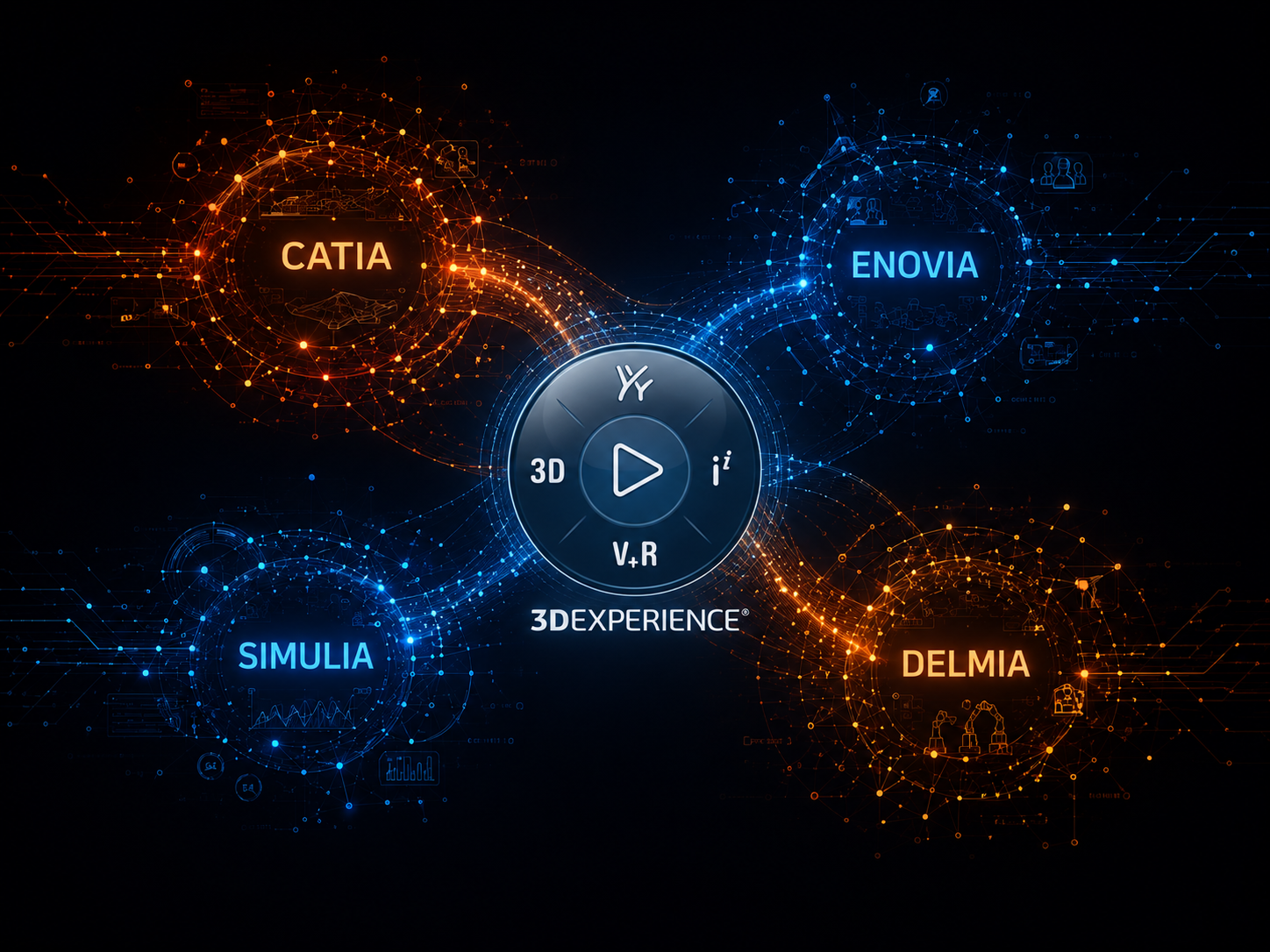
3DEXPERIENCE unifies Dassault Systèmes' engineering, simulation, manufacturing, and business applications on a single data backbone. Users work through role-based apps — each function accesses exactly the capabilities it needs, all operating on the same underlying product data.
✏️
CATIA — Product Design
Multi-discipline CAD covering parametric modeling, surface design, assembly engineering, systems architecture, and manufacturing preparation.
📋
ENOVIA — Lifecycle Management
BOM management, configuration control, change management, project governance, and cross-team collaboration workflows.
🔬
SIMULIA — Realistic Simulation
Structural analysis, fluid dynamics, electromagnetics, thermal analysis, and multiphysics for performance validation before physical prototypes.
🏭
DELMIA — Digital Manufacturing
Process planning, robotic simulation, plant layout, work instructions, and manufacturing execution management on the same data model.
Five Things That Actually Change
01
Single Source of Truth
All product data — geometry, BOM, documents, requirements, simulation results — lives in one place. Every team accesses the same object. There's no "which version?" question because there's only one version of record at any point.
02
Real-Time Cross-Discipline Collaboration
Design, simulation, and manufacturing teams work on connected data simultaneously. A geometry change is immediately visible to the simulation engineer and manufacturing planner — no email, no file transfer, no delay.
03
End-to-End Process Coverage
From early concept through detailed design, simulation, manufacturing planning, and production execution — the platform covers the complete development lifecycle without handoff gaps between systems.
04
Governance Built Into the Data Model
Change management, approvals, and configuration control are not add-ons — they're embedded in the platform's architecture. Every change to a product goes through a controlled, traceable process by design, not by policy.
05
Business Visibility Alongside Engineering
Program dashboards and milestone tracking connect directly to engineering data. Management sees live program health — not a PowerPoint summary built from yesterday's exports.
The 30% Reduction — What It Actually Means
Dassault Systèmes cites that companies can reduce up to 30% of non-value-added activities on the 3DEXPERIENCE platform. That's not saying you'll design 30% faster. The 30% is about time currently wasted on system friction — searching for data, resolving version conflicts, re-entering information between systems, coordinating meetings that only exist because tools don't talk.
On the platform, that overhead compresses. The time doesn't disappear — it gets redirected to actual engineering work. For a large program, that's a significant shift in where engineering capacity goes.
🎯
The bottom line
3DEXPERIENCE isn't a better version of the tools you already use. It's a different paradigm for how product development works — one where the system architecture stops fighting the engineering process and starts supporting it.
Written from hands-on experience working with Dassault Systèmes tools across Transport & Mobility and Aerospace & Defence programs. Views are my own.