PLMDigital Manufacturing
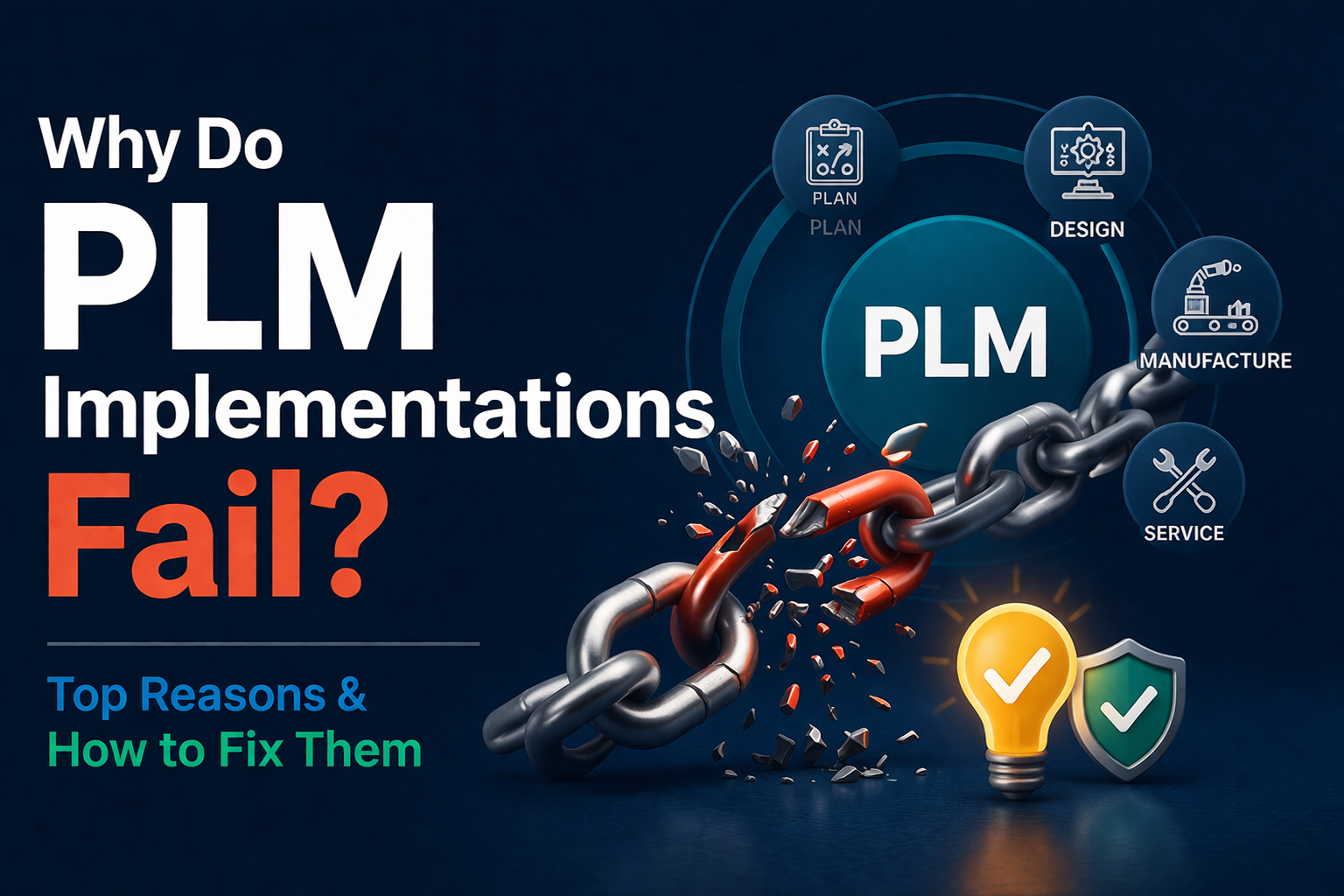
Why Do PLM Implementations
Fail?
The technology is mature. The business case is clear. And yet PLM projects keep underdelivering. Here's an honest breakdown of the 10 root causes — and what actually fixes them.
·Apr 6, 2026
·9 min read
·PLM · Digital Manufacturing
The pitch is always the same. A PLM system will create a single source of truth, improve cross-functional collaboration, reduce time-to-market, and give leadership real visibility into product health. The investment proposal gets approved. The project kicks off. A year later, engineers are still working in Excel, approvals are still stuck in email chains, and the system that cost crores to implement is functioning mainly as an expensive document storage tool.
This pattern is common enough that it deserves a direct examination. Not because PLM tools are bad — they aren't. ENOVIA, Teamcenter, Windchill — these are mature, powerful platforms with years of development behind them. The problem is almost never the tool. It's how the implementation is approached.
80%
Failure is execution, not tool
1
Honest assessment needed first
The Uncomfortable Starting Point
Most organizations start their PLM journey with a vague mandate: "We need a PLM system." That statement is not a business objective. It's a category of solution in search of a problem definition. Without clarity on what specific problems the system needs to solve — and what measurable outcomes define success — the implementation has no real target to hit. It becomes a technology deployment project, not a business transformation.
⚡
The 20/80 rule of PLM
PLM success is 20% tool selection and 80% execution. The organizations that get strong ROI from PLM investments are almost always the ones that invested heavily in the 80% — process design, change management, stakeholder alignment, and governance — not the ones that bought the most expensive platform.
10 Reasons PLM Implementations Fail
01 — Strategy
No Clear Business Objectives
Vague goals like "better collaboration" produce vague outcomes. Without specific KPIs — design cycle time, change approval lead time, BOM accuracy — there's no way to measure success or failure.
02 — Framing
Treating PLM as an IT Project
PLM is a business transformation touching engineering, manufacturing, quality, supply chain, and finance. When it's owned and driven by IT alone, business alignment disappears before go-live.
03 — Discovery
Poor Requirement Gathering
Generic requirements gathered from managers rather than actual users produce a system that performs perfectly in demos and fails in daily use. Real workflows are messier than org charts suggest.
04 — Architecture
Over-Customization
Every heavily customized PLM system is creating a future maintenance problem. Customizations break on upgrades, compound over releases, and make the system increasingly expensive to support. Use standard capabilities wherever possible.
05 — People
Weak Change Management
Engineers resist change when they don't understand why it's happening, weren't involved in the design, and received minimal training. Adoption is not automatic — it has to be engineered with as much care as the system itself.
06 — Governance
No Stakeholder Ownership
When decisions are made by IT or external vendors without cross-functional business ownership, the resulting system reflects what the vendor knows, not what the business needs. PLM requires active ownership from engineering and manufacturing leadership.
07 — Data
Dirty Data Migration
Migrating legacy data without cleaning it first fills the new system with duplicates, inconsistencies, and incomplete records. A modern platform running on legacy data quality produces legacy outcomes.
08 — Timeline
Unrealistic Expectations
PLM is not a quick win. Large-scale implementations take 12–24+ months to stabilize, and ROI builds over years as processes mature. Leadership expecting rapid payback creates pressure that shortcuts the work that generates value.
09 — Integration
Weak Integration Strategy
PLM that doesn't connect to CAD (CATIA, NX, SolidWorks) and ERP (SAP, Oracle) creates new silos instead of eliminating old ones. Integration architecture deserves as much attention as the PLM platform itself.
10 — Dependency
Over-Reliance on Vendors
An organization that can't configure, support, or evolve its own PLM system is permanently dependent on external consultants for every change. Internal capability must be built during implementation, not after.
Warning Signs Your Implementation Is in Trouble
These signals appear well before a project is officially acknowledged as struggling. If you recognize several of them, the issue isn't the platform — it's the approach.
Engineers still using Excel for BOM management
Low system login rates after go-live
Workarounds documented as "standard process"
Approvals still happening via email
Regular "which version is correct?" meetings
Users requesting system access removal
Frequent complaints about system complexity
IT managing PLM with no engineering input
The hard truth
When a PLM system is bypassed by its intended users, the system isn't failing — the implementation is. The tool doesn't know it's being ignored. Only the people who built the business case do. And the fix almost never involves buying a different platform.
7 Ways to Get PLM Right
🎯
Define Measurable Business Goals First
Tie PLM to specific outcomes: reduce ECO cycle time from 3 weeks to 5 days, reduce BOM errors reaching production by 80%, eliminate manual ERP data entry. Vague goals produce vague results.
🗺️
Map Processes Before Configuring the System
Document current AS-IS workflows in detail. Design optimized TO-BE workflows with actual users — not assumptions. Configure the system to support the redesigned process, not to replicate the old one digitally.
⚙️
Minimize Customization — Ruthlessly
Challenge every customization request with: does this deliver clear business value that the standard configuration cannot? If the answer requires a long explanation, it's probably not worth it.
👥
Treat Change Management as a Workstream
Structured user training, executive communication about why this matters, super-user networks, and continuous support post go-live. Adoption doesn't happen without deliberate investment in the people side.
🏛️
Establish Cross-Functional Governance
A PLM steering committee with real authority from engineering, manufacturing, and quality leadership. Defined roles, decision rights, and escalation paths. Without governance, the system drifts.
📈
Phase the Rollout — Start Small, Scale on Success
A pilot program on one product line or one business unit reveals real-world gaps that no workshop or demo ever surfaces. Use the pilot to refine the approach before organization-wide deployment.
🧠
Build Internal PLM Capability Deliberately
Train internal team members to configure, support, and evolve the system. Every dollar spent building internal expertise reduces permanent vendor dependency and increases the organization's ability to get value from the investment over time.
🏁
The bottom line
PLM systems don't fail. PLM implementations fail — because organizations underestimate the process and people work relative to the technology work. Done right, PLM transforms how products are built and managed. Done wrong, it becomes the most expensive system nobody uses. The difference is almost always in the 80%.
For more on how PLM platforms work in practice, see the overview of ENOVIA and the product lifecycle backbone, or the broader context on the 3DEXPERIENCE platform.
Written from hands-on PLM implementation experience across Transport & Mobility and Aerospace & Defence programs. Views are my own.