What do robots do in electronics manufacturing?
Electronics became the biggest user of new industrial robots in 2025, ahead of automotive. Our group at UCD set out to answer three practical questions about that. Where do robots fit in electronics manufacturing, what do they cost, and how fast does the money come back?
We wrote a report and gave a presentation. This page summarises the whole project. I went deeper on my own part, the robot lifecycle and return on investment, and I built a robot cell in KUKA.Sim to test the ideas, which has its own page: KUKA.Sim SCARA PCB assembly simulation.
Why electronics is hard for robots
Four features of the industry shape every robot decision.
Miniaturisation and precision
Electrostatic discharge (ESD)
Cleanliness and contamination
Frequent product changes
Three real cases, three different jobs
The report looks at one case each for inserting parts, soldering and testing.
| Company | Robots | Job | Reported result |
|---|---|---|---|
| Toyo Electric (Japan) | 3 × Kawasaki duAro dual-arm SCARA | Sort 14 connector types, insert connectors, move boards to and from soldering | A camera on the robot hand finds marks on the board and corrects the insertion position |
| Delta Systems (Ohio, USA) | 5 × Epson SCARA | Load and unload parts, solder hour meters for tractors and utility vehicles | About 750,000 meters and 2.25 million+ solder joints a year. Built in-house at about half the price of a ready-made system (company estimate) |
| Koyo Electronics (Japan) | Universal Robots UR3 cobot | Touchscreen functional testing with a stylus | 31% higher productivity, post-inspection staff from two to one (company-reported) |
The lesson is the same in all three. The arm is the easy part. The gripper, the part position, the vision system and the link to other machines decide whether the cell works. Delta had to join its robots to commercial soldering equipment that spoke different protocols. Koyo had to lighten a fixture, run a safety assessment and slow its cobot at first because staff were uncomfortable with it.
Which robot for which job
Matching the robot's movement to the task matters more than any single spec. SCARA suits the flat work that makes up most board assembly, which is why I chose one for my simulation.
| Type | Best at | Example in our report |
|---|---|---|
| SCARA | Fast, stiff movement across a flat surface: chip placement, screws, soldering | Epson T6-B and Stäubli TS2-60: repeatability 0.01 to 0.04 mm |
| Six-axis arm | Reaching in full 3D: micro-soldering, coating, wafer movement | Comau Racer-3 (0.02 mm accuracy); Stäubli TX2-200 carries up to 170 kg in cleanrooms |
| Delta robot | Very fast light sorting and packing, about 100 to 300 picks a minute | Payload roughly 0.3 to 8 kg |
| Cartesian (gantry) | Straight-line moves: probing and test work, board assembly | Festo EXCM gantry: 0.1 mm positioning accuracy |
| Collaborative robot (cobot) | Working next to people without a safety cage; quick to set up for new products | ABB YuMi: 7 joints per arm, 500 g payload, programmed by guiding the arm by hand |
People, robots or a hybrid line
Manual assembly
Full automation: strengths
Full automation: limits
Hybrid lines
The robot lifecycle in an electronics plant
A robot has a life of its own, separate from the product it builds. It is bought, installed, run, changed over when the product changes, and finally upgraded or retired. Cost, time, quality and flexibility shift at each stage. This table shows what the reported cases say.
| Stage | What the cases report | Source |
|---|---|---|
| 1 · Select and buy | Delta Systems built its soldering line in-house for about half the price of a ready-made one (company estimate) | ASSEMBLY Magazine, 2023 |
| 2 · Install | Commissioning on a digital twin cut commissioning time by 75% at one automotive-electronics plant. Offline programming cut programming time by 70% in one vendor case (heavy-equipment attachments, not electronics) | WEF Global Lighthouse Network, 2025; Visual Components, 2025 |
| 3 · Run | Time per task or lead time down 50% to 85%. Quality losses and scrap cost down 49% to 56%. One Foxconn site cut unplanned downtime by 90% | WEF Global Lighthouse Network, 2025 |
| 4 · Change over | One semiconductor plant cut time to prototype a new product by 30%. Qisda runs one line across many product models | WEF, 2025; Digitimes, 2019 |
| 5 · Upgrade or retire | We found no electronics case with numbers for this stage | n/a |
When the money comes back
Payback time is the investment divided by the yearly saving. The investment is the robot, the tooling and the integration. The saving comes from labour, output and fewer defects. Reported paybacks in four electronics cases run from 12 to 24 months.
| Case | Reported payback | Scale (30 months) |
|---|---|---|
| KOYO, touchscreen testing | 12 months | |
| GLAUB, placing parts on three shifts | 12 months | |
| Melecs, packing circuit boards | under 18 months (expected) | |
| Schneider Electric, circuit-breaker automation | about 24 months | |
| JVC Electronics Indonesia (fifth case) | 30 months |
Two levers shorten payback. Spend less, by building in-house and commissioning virtually. Or save more, by running more hours (GLAUB's 12 months is on three shifts), cutting downtime and changing over faster.
Where robots in electronics are heading
Electronics overtook automotive in 2025, with 142,000 installations against 139,000. About 74% of installations in 2024 were in Asia.
Lights-out factories, which run with little or no human presence, already exist in parts of the industry: wafer transport, component placement and optical inspection. Full lights-out is held back by very small components, cables and other flexible parts, expensive changeovers that still need people, and the high up-front cost. Our report's view is that partial lights-out grows first, and that adaptive AI decides how far the rest goes.
Testing the ideas in a KUKA.Sim cell
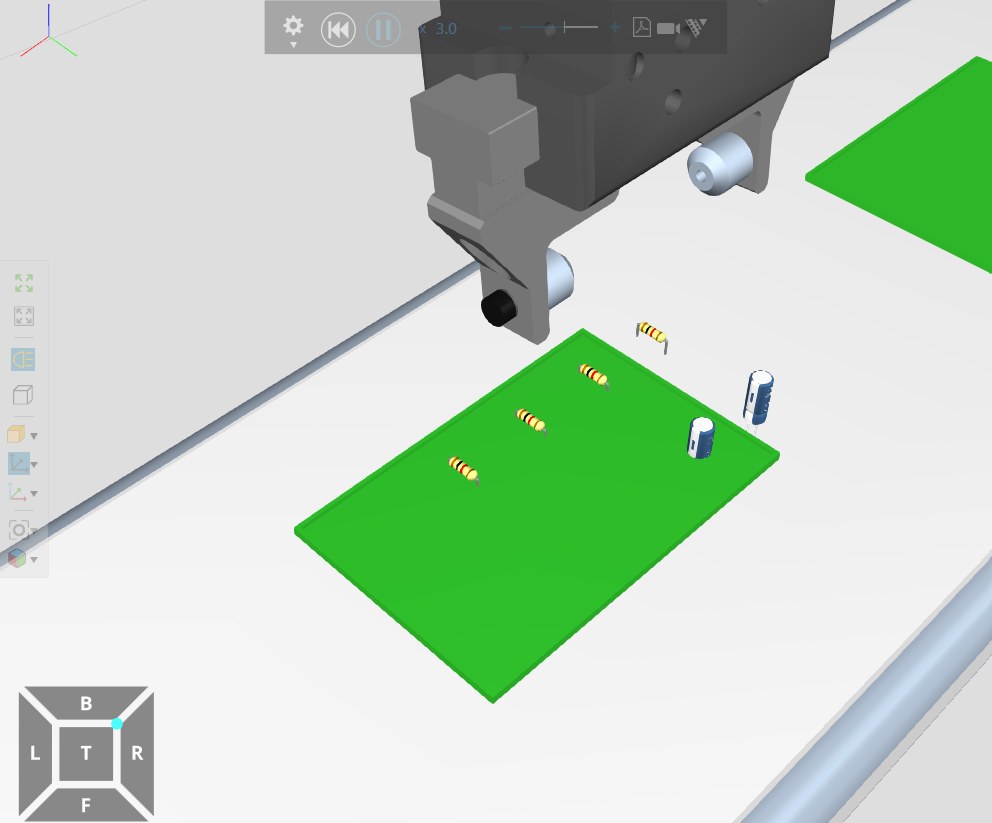
To see how a robot handles electronics assembly in practice, I built a cell in KUKA.Sim 4.10. A KUKA KR 6 R700 Z200-2 SCARA places 14 real component models on a PCB and rejects one chip into a bin. The run takes about 44 seconds, timed by stopwatch with an error of about 2 seconds. It has no vision system, so the time is an ideal one and a real cell would be slower.
Full build, KRL code and lessons learnedKUKA.Sim SCARA PCB assembly simulation →Common questions
How long does a robot take to pay back in electronics manufacturing?
Why are SCARA robots so common in PCB assembly?
Can robots fully replace people in electronics factories?
What are the stages of a robot's lifecycle in a factory?
Where the numbers come from
- International Federation of Robotics (2026). World Robotics 2026, Industrial Robots, Executive Summary.
- Kawasaki Robotics. Toyo Electric printed circuit board mounting process fully automated.
- ASSEMBLY Magazine (2023). SCARA robots solder circuit assemblies (Delta Systems).
- Epson (2023). Delta Systems case study.
- Universal Robots. Koyo Electronics Industries: reliable UR cobot boosts productivity by 31%. Melecs and Schneider Electric case stories from the same site.
- ABB (2021). GLAUB through-hole assembly case study. Digitimes (2019). Qisda case.
- World Economic Forum (2025). Global Lighthouse Network. Visual Components (2025). AMI Attachments case.
Company-reported figures are labelled as such in the text. This page summarises a student group project and is not independent research.