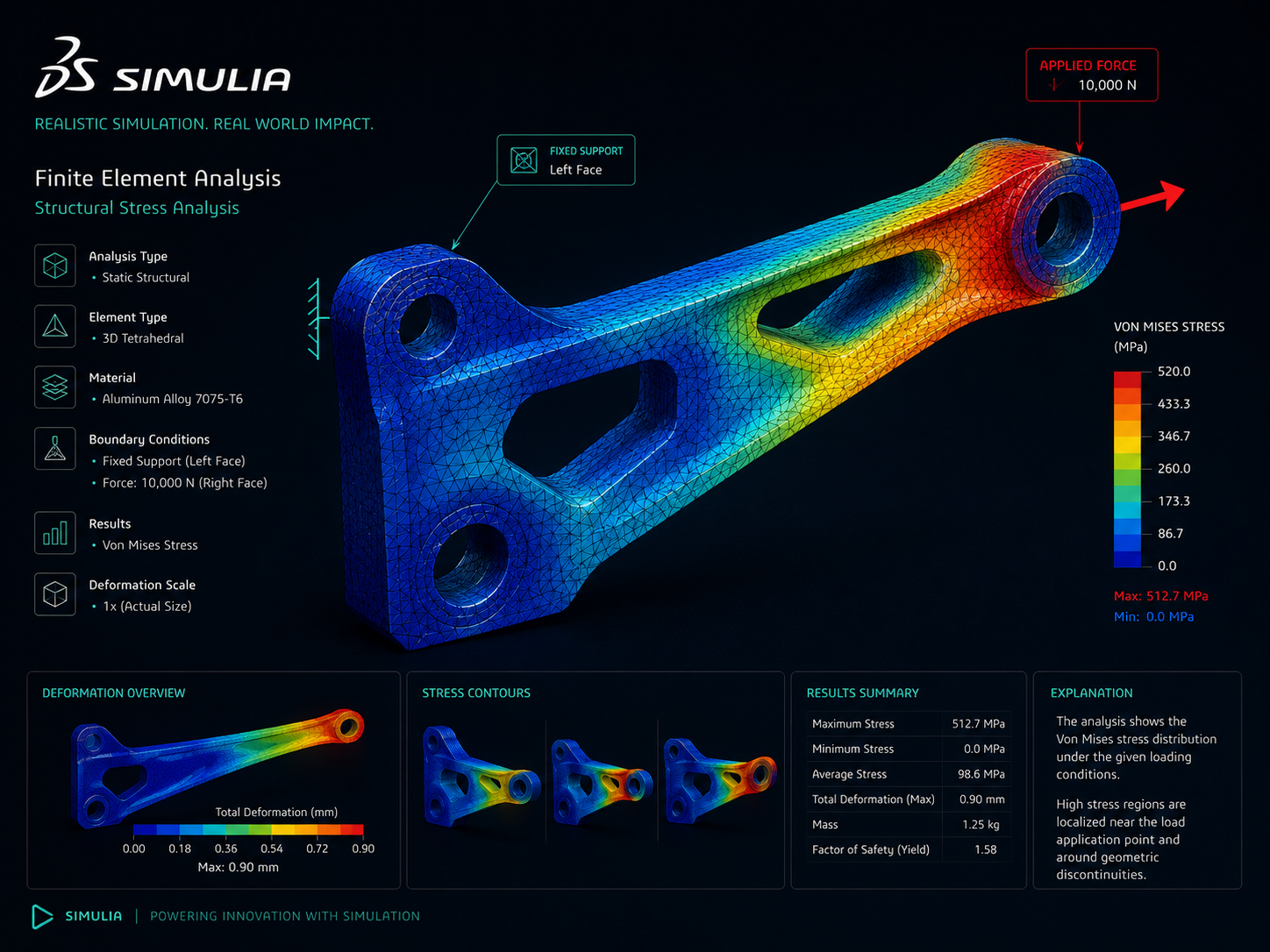
Physical testing is expensive, time-consuming, and — in some cases — impossible to perform on a product that doesn't yet exist. SIMULIA is Dassault Systèmes' answer to this: a suite of advanced simulation tools that let engineers test product behavior digitally, with the fidelity and reliability needed to make real engineering decisions from the results.
When integrated with CATIA design data on the 3DEXPERIENCE platform, SIMULIA becomes part of a continuous design-simulate-refine loop — not a separate analysis step that happens after design is done. This changes how simulation fits into the development process: from validation at the end to guidance throughout.
The Simulation Disciplines SIMULIA Covers
SIMULIA's flagship solvers — Abaqus, XFlow, CST Studio, and others — cover a broad range of physics domains. Most engineering programs don't need all of them, but having them available on the same platform, working on the same product data, is a significant advantage for complex products where multiple physics interact.
Simulation-Driven Design — Not Just Validation
The traditional role of simulation in product development was validation: design the product, then run simulations to check it meets requirements. If it didn't, iterate. This cycle could take weeks per loop, limiting how many design alternatives could be explored.
SIMULIA on 3DEXPERIENCE enables a different approach: simulation as a design guide rather than a gate. Because simulation connects directly to CATIA geometry on the same platform, the feedback loop compresses dramatically. Design changes propagate into the simulation model automatically. Engineers can run analysis early, often, and cheaply — exploring design space rather than validating a single point.
Multidisciplinary Simulation for Modern Products
Modern complex products — electric vehicles, next-generation aircraft, advanced electronics — don't fail in one physics domain at a time. A battery pack failure involves electrochemistry, thermal runaway, structural integrity, and venting fluid dynamics simultaneously. An aircraft structural component must satisfy aerodynamic loading, thermal gradients, and fatigue simultaneously.
SIMULIA's multiphysics capabilities address this directly. Rather than running separate analyses in separate tools and manually coupling the results, engineers can build coupled simulations where thermal, structural, and fluid effects interact in a single model. The accuracy of these coupled analyses is significantly higher than sequential single-physics runs — and the insights they produce are richer.
Reducing Physical Testing — Practically and Economically
Physical testing will never disappear entirely. Regulatory requirements, safety certification, and the irreducible complexity of real-world conditions mean physical validation remains necessary. But SIMULIA enables a significant reduction in the number and scope of physical tests required.
- Test-by-analysis strategies allow regulatory submissions backed by simulation evidence, reducing the physical test campaign
- Virtual test laboratories replicate standardized test protocols digitally, allowing unlimited iteration before physical execution
- Failure mode exploration — testing conditions that are dangerous, expensive, or impossible to reproduce physically — is feasible digitally
- Supplier qualification can be partially supported by simulation, reducing lead times on supplier development
SIMULIA represents the shift from "test to validate" to "simulate to understand" — a fundamental change in how engineering confidence is built during product development. The organizations that have made this shift most completely are, systematically, the ones that bring better products to market faster.
Written from hands-on experience working with Dassault Systèmes tools across Transport & Mobility and Aerospace & Defence programs. Views are my own.