There's a gap that exists in most manufacturing companies, and it's expensive. Engineering finishes a design and hands it off. Manufacturing figures out how to build it. The two sides of that handoff often work from different assumptions, different data, and different timelines — and the product pays the price in rework, delays, and production inefficiency.
DELMIA was built specifically to close that gap. It's Dassault Systèmes' digital manufacturing and operations platform — and on 3DEXPERIENCE, it works directly on the same product data that engineering designs in CATIA, making the handoff less of a handoff and more of a continuous, connected process.
What DELMIA Actually Does
DELMIA covers two broad domains: manufacturing engineering — how you plan and validate production processes — and operations management — how you run them. Most manufacturing software tools handle one or the other. DELMIA handles both, and on 3DEXPERIENCE they share the same data backbone.
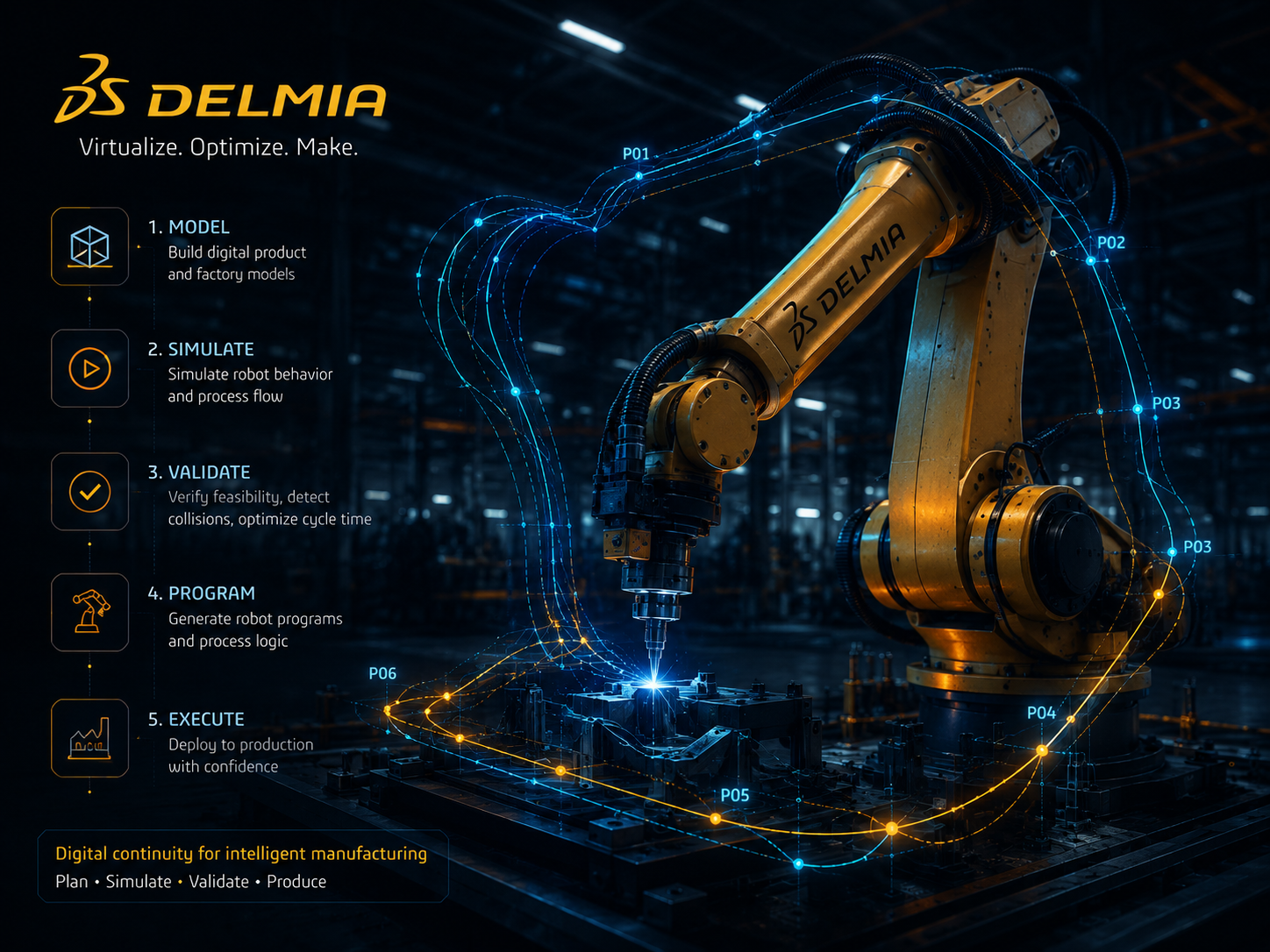
Manufacturing engineers use DELMIA to define production processes before anything is physically built. A process planner can lay out a factory, simulate robot paths, validate ergonomics, program NC machines, and identify bottlenecks — all digitally, all before a single part is cut.
Virtual Commissioning and Digital Twins
One of DELMIA's most significant capabilities is virtual commissioning — the ability to validate an entire production system digitally before it's physically built or activated. This means running the PLC logic, robot programs, and production sequences against a virtual model of the factory to catch problems before they become expensive physical realities.
This connects directly to the concept of a manufacturing digital twin. DELMIA maintains a virtual representation of the production environment that mirrors physical reality — updated with real-time data from shop-floor sensors and systems. Teams can use this twin to test process changes, simulate what-if scenarios, and predict performance before committing to changes on the floor.
The Integration Advantage on 3DEXPERIENCE
DELMIA running on 3DEXPERIENCE has a structural advantage over standalone manufacturing tools: it reads from the same product data model that CATIA writes to. When engineering updates a part geometry, the change is immediately visible in DELMIA's process plans. When a manufacturing engineer defines an assembly sequence, the operation data connects to the engineering BOM.
This eliminates the most common failure mode in design-to-manufacture handoffs: manufacturing planning based on outdated engineering data. On 3DEXPERIENCE, manufacturing and engineering work on the same version of the product simultaneously — not sequentially.
- Manufacturing BOM is derived from the engineering BOM — structured and updated in the same environment
- Work instructions reference the actual 3D geometry, not exported flat documents
- Change management propagates through both engineering and manufacturing processes via ENOVIA workflows
- Quality data feeds back into the design loop — production findings inform engineering decisions
Operations Management — Where Planning Meets Execution
Beyond process planning and simulation, DELMIA extends into manufacturing execution — the day-to-day management of production. This includes production scheduling, work order dispatching, resource allocation, and real-time monitoring of shop-floor performance against plan.
The connection between planning and execution on the same platform means the production schedule isn't just a spreadsheet — it's tied to the actual process definitions, resource capacities, and product configurations that engineering has validated. When something changes in production, the deviation is visible against the planned baseline immediately.
DELMIA answers a simple question that has historically been complicated: what's the fastest way to get from a validated design to a running production system? The answer, on 3DEXPERIENCE, is to never fully separate the two.
Written from hands-on experience working with Dassault Systèmes tools across Transport & Mobility and Aerospace & Defence programs. Views are my own.