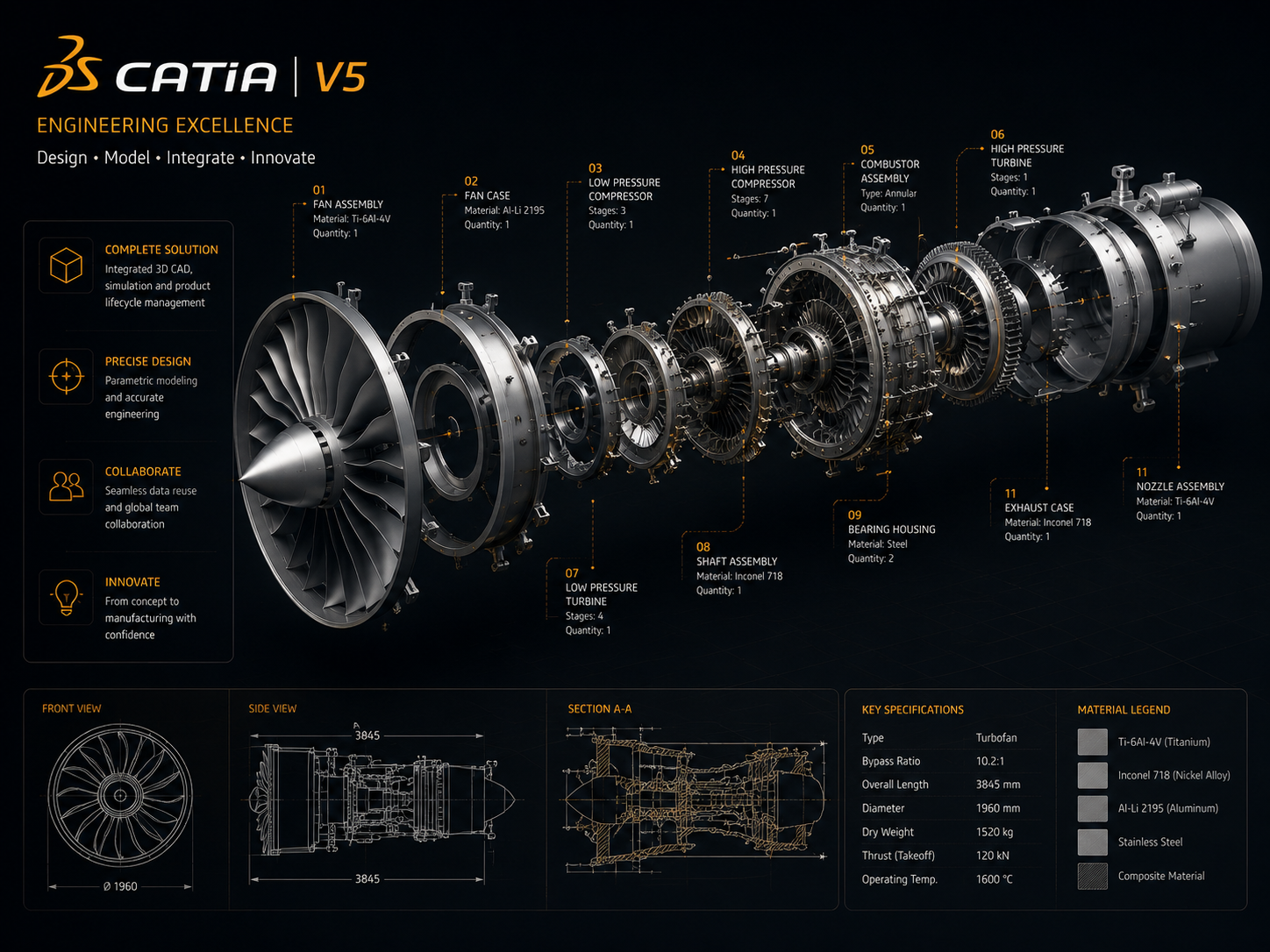
There's a reason CATIA V5 is still running production programs at some of the world's most demanding engineering organizations. It isn't nostalgia. It isn't inertia. CATIA V5 is an extraordinarily capable mechanical design system that, after decades of continuous development, does exactly what complex manufacturing industries need — with the kind of proven stability that enterprise-scale programs require.
This article covers CATIA V5 specifically — the desktop-based version, distinct from the newer CATIA on 3DEXPERIENCE. Both are part of Dassault Systèmes' portfolio, but V5 has its own character: mature, deep, and extensively embedded across aerospace, automotive, and industrial engineering workflows worldwide.
Part Design — Parametric Solid Modeling
CATIA V5 Part Design is built around fully parametric, feature-based solid modeling. Parts are built up as a sequence of features — pads, pockets, fillets, holes, patterns — each driven by constrained sketches. The feature history tree is not just a record of what was done; it's a live dependency chain. Change a dimension in an early sketch and V5 rebuilds the part through the entire tree, propagating the change consistently.
This parametric foundation is what makes V5 suitable for engineering-intent design. Parts don't just capture geometry — they capture the relationships and constraints that define how the geometry should behave when design parameters change. Knowledge-based design rules can be embedded directly, so parts self-validate against engineering requirements.
Assembly Design — Managing Complexity at Scale
CATIA V5 Assembly Design handles the complexity that makes large-product engineering hard. Multi-level product structures, mechanical constraints, kinematics, clash analysis, and mass property calculations — all within a single environment that can manage assemblies with thousands of components without losing its structural integrity.
- Mechanical constraints define how components relate — coincident, concentric, offset — and drive assembly behavior
- Kinematics simulation validates mechanism motion ranges and checks for interference throughout the motion envelope
- DMU (Digital Mock-Up) enables clash detection and space reservation analysis across large assemblies
- Multi-level BOM is structured directly from the assembly tree, maintaining traceability between product structure and component data
For automotive body-in-white design or aerospace structural assemblies — where thousands of parts must fit together precisely — V5's assembly environment is the tool of choice for a reason.
Generative Shape Design — Advanced Surface Modeling
If parametric solid modeling is where V5 excels for mechanical parts, Generative Shape Design (GSD) is where it excels for surfaces. GSD provides tools for creating complex, high-quality surface geometry — the kind required for automotive exterior panels, aerospace aerodynamic surfaces, and industrial styling.
Class-A surface quality — meaning surfaces that meet automotive industry standards for curvature continuity and reflection quality — is achievable directly in V5. Curvature combs, reflection line analysis, and surface continuity checking tools are embedded in the workflow, not bolted on as post-processing steps.
Why Industries Still Run on CATIA V5
When newer cloud-based tools exist, the natural question is: why stay on V5? The answer isn't resistance to change. There are real, substantive reasons why V5 remains the primary design backbone at major aerospace and automotive OEMs:
CATIA V5 is not trendy. It is established, industrial-grade, and proven across the most demanding engineering environments in the world. For mechanical engineers working on complex products, it remains one of the most capable and reliable tools available — and understanding it is not optional for serious product development work.
Written from hands-on experience working with Dassault Systèmes tools across Transport & Mobility and Aerospace & Defence programs. Views are my own.