
What is Change Management Process? Engineering Change Management (ECM) Guide
This refers to the engineering change management process or simply known as ECM. This basically explains the whole process, Change request, change order and change action in ECM process.
ENOVIA
One uncontrolled design change can disrupt an entire production line.
Imagine this.
An engineer updates a small design detail in a component and shares the updated file with a few team members.
Soon confusion starts.
Production is still using the old drawing
The supplier receives another version
Quality checks a different revision
Within weeks, parts don’t match and production slows down.
Meetings begin with the same question:
“Which is the latest version?”
This situation is common in manufacturing. Even a small change in design, material, or process can impact multiple teams — engineering, manufacturing, quality, procurement, and suppliers.
Without a structured system, managing these changes becomes chaotic.
This is where Engineering Change Management (ECM) comes in.
What is Engineering Change Management (ECM)?
Engineering Change Management is a structured way to manage product changes.
Instead of random updates through emails or shared folders, every change follows a defined process.
A change is:
Requested
Reviewed
Approved
Implemented
This ensures everyone in the organization works with the latest and approved product information.
Why ECM is Needed?
A product change rarely affects just one team.
For example:
A design change affects manufacturing drawings
A material change impacts suppliers
A dimension change affects quality inspection
Without control, companies face problems like:
Multiple design versions
Outdated drawings in production
Lack of traceability
Rework and delays
ECM ensures that every change is controlled and traceable.
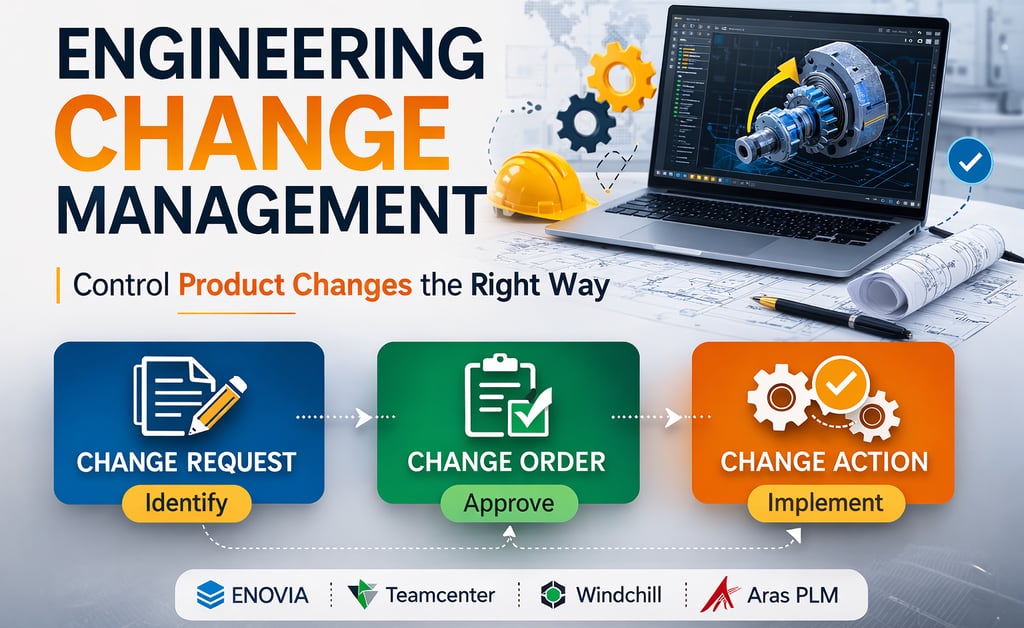
The ECM Process
Engineering Change Management typically follows three steps.
Change Request → Change Order → Change Action
Each stage manages a different part of the change lifecycle.
Change Request (CR)
The Change Request is where a change is proposed.
It captures:
The problem or improvement
Reason for change
Affected parts or documents
At this stage, the change is not yet approved.
Change Order (CO)
The Change Order is the approval stage.
Stakeholders review the request and evaluate its impact.
If approved, the organization authorizes the change.
Change Action (CA)
The Change Action is the implementation stage.
Typical actions include:
Updating CAD models
Revising drawings
Updating BOMs
Once completed, the change becomes part of the official product configuration.
ECM in PLM Systems
Most companies manage ECM using PLM systems.
Examples include:
Teamcenter
Windchill
Aras PLM
These systems automate change workflows, manage approvals, and maintain complete traceability of product changes.
Key Takeaway
Engineering Change Management ensures product changes are controlled and traceable.
The process is simple:
CR → CO → CA
Change Request → Identify the change
Change Order → Approve the change
Change Action → Implement the change
© 2026 Chandan N