A telescope that works and a bill that nearly doubled
The James Webb Space Telescope (JWST) works. It deployed almost exactly as planned. It also cost about US$9.7bn against a US$4.96bn plan, and it launched 90 months late.
My group spent about two months working out how that happened. This post is what we found, and where I think the lesson is bigger than one telescope.
The project: a group case study of JWST
This was a group case study for MEEN40800 Engineering Project Management: Tools and Techniques, part of my MEngSc in Robotics and Intelligent Manufacturing at University College Dublin (UCD). Four of us worked on it as Group 5.
The brief: pick a major public engineering project and study it through three topics from the module. Estimating times and costs. Risk management. Monitoring and control.
There were three deliverables. An interim report worth 10% of the grade, where we scored 71%. A final report worth 20%, capped at 2,500 to 3,000 words, and ours came to about 2,820 plus appendices. And a 6-minute group presentation worth 20%, with all four of us speaking across 22 slides. We submitted on 15 November 2026 and presented on 16 November.
We also held ten recorded group meetings between 21 September and 10 November 2026. The minutes sit in the report appendix, and every action has an owner and a deadline.
Our research question was simple. JWST works brilliantly, so how was it managed, and what should the next big engineering project do differently? We kept to the development phase, from the 2009 baseline to launch on 25 December 2021, and used public sources only: NASA review panels (the ICRP in 2010 and the IRB in 2018), US Government Accountability Office (GAO) audits from 2012 to 2021, the NASA Office of Inspector General (OIG) report from 2012, and journal papers. For theory we used Larson and Gray (2021) and the lecture material. The method was to set what theory says against what JWST actually did. The gap between the two is the finding.
Why JWST was hard to build
Almost every part was new technology, and everything had to work first time.
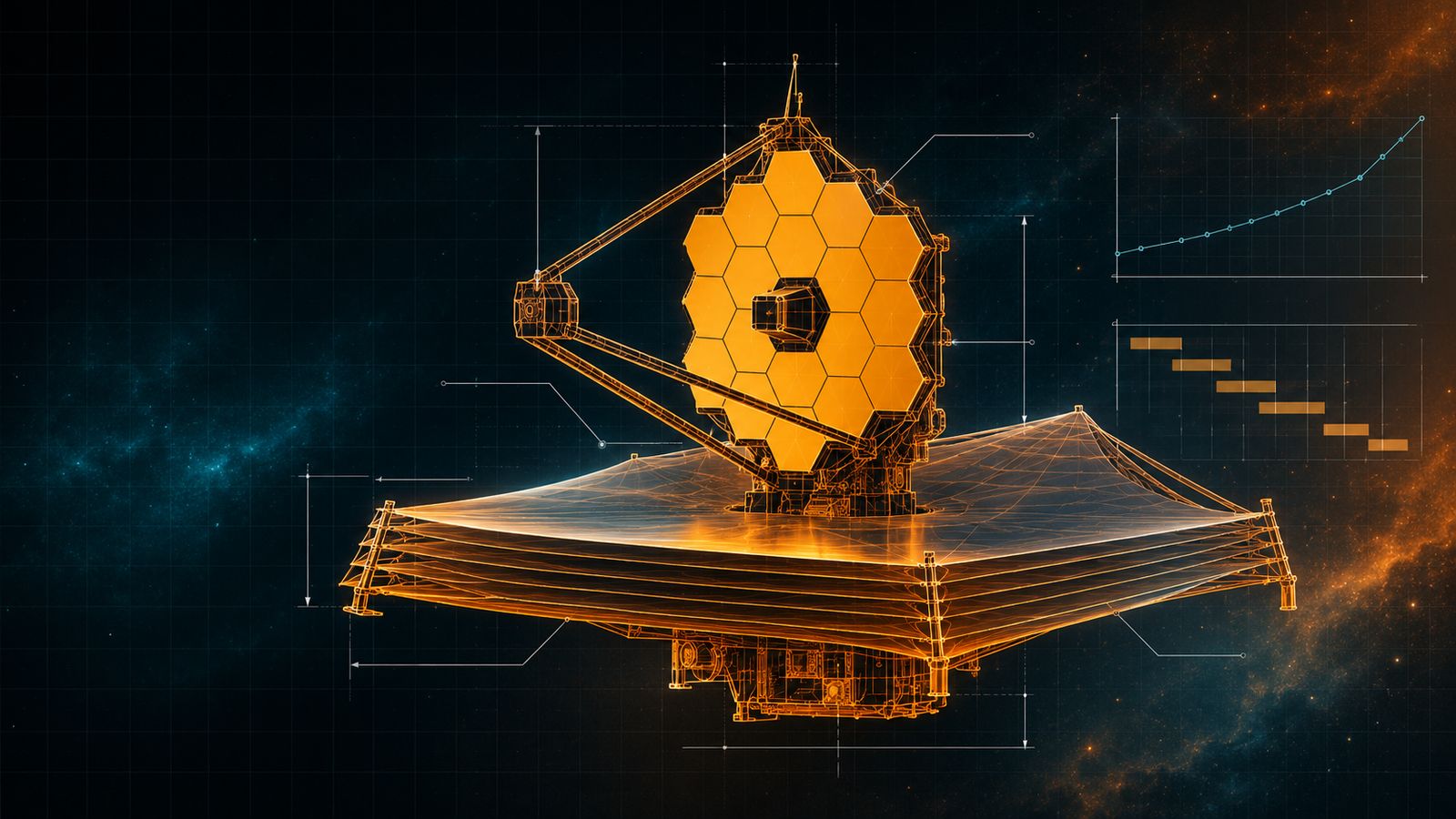
The mirror is 6.5 m wide and made of 18 gold-coated beryllium segments. Hubble's mirror was 2.4 m. JWST's had to fold to fit inside an Ariane 5 rocket and then unfold itself in space.
It observes in infrared, so it has to run at about 50 K, around minus 220 °C. A five-layer sunshield about the size of a tennis court keeps it cold. And it sits about 1.5 million km from Earth. Hubble was about 540 km up and astronauts fixed it. Nobody can reach JWST.
The partnership was large too. NASA led, and Goddard Space Flight Center ran the project. The European Space Agency (ESA) supplied instruments and the Ariane 5 launch. The Canadian Space Agency (CSA) supplied a guidance sensor. Northrop Grumman was the prime contractor. In total, 14 countries, 29 US states and 258 organisations took part.
The timeline in numbers
| Date | What happened |
|---|---|
| 2009 | The baseline (the approved plan) is set: US$4.96bn, launch June 2014 |
| 2010 | An independent panel (the ICRP) finds the real cost is about US$6.5bn, with launch around September 2015. It also finds no current bottom-up estimate behind the budget, cost reported red in 7 of 9 quarters with no reset, reserves too low, and authority split between NASA HQ and Goddard |
| July 2011 | A US House subcommittee draft budget proposes cancelling JWST. The project survives with a US$8bn development cap |
| 2011 | Replan: US$8.84bn, launch October 2018. This plan holds for about six years |
| 2012 | GAO finds 14 months of schedule reserve, but only 7 months for the last three of five integration and test phases |
| 2015 | GAO finds the contractor's earned value data unreliable |
| 2017 to 2018 | Four launch slips in under three years, starting once the parts are integrated and tested |
| March 2018 | Workmanship errors found in testing: valves cleaned with the wrong solvent and loose sunshield fasteners. The contractor is hitting only about 50% of its planned schedule |
| June 2018 | The Independent Review Board (IRB) estimates a 29-month slip costing about US$1bn (IRB, 2018), roughly US$35m per month of delay. Replan: US$9.66bn, launch March 2021 |
| July 2020 | COVID-19 and remaining sunshield work move launch to late 2021 |
| 25 Dec 2021 | Launch. Deployment goes to plan, the precise launch leaves fuel for 10+ years of science, and 207 contingency plans were ready by 2021 |
Two replans, in 2011 and 2018. Cost variance of about +US$4.7bn. Look at the pattern: the first budget was wrong, the fix was too small, and the real bill arrived in integration and test.
The tools we used and what they showed
Work breakdown structure (WBS). We split JWST into six level-2 packages: project management (NASA HQ and Goddard), the optical telescope (Northrop Grumman and Ball Aerospace), science instruments (Goddard, ESA, CSA and the University of Arizona), spacecraft and sunshield (Northrop Grumman), integration and test (Goddard, Johnson Space Center and Northrop Grumman), and launch and operations (ESA and the Space Telescope Science Institute). Every package meets in integration and test. That is exactly where the late problems appeared.
Cost and schedule baselines. JWST was re-baselined twice, in 2011 and 2018, and the cost variance was about +US$4.7bn.
Power and interest grid. Congress has high power, and it lost trust after the cancellation draft and the US$8bn cap. Northrop Grumman has high power and needed closer oversight. NASA HQ and Goddard have high power too, but split authority meant nobody clearly owned the decision to reset the plan. ESA and CSA were managed well and delivered their instruments and a precise launch. Astronomers and other missions have high interest and low power, and they paid the most. WFIRST (now the Nancy Grace Roman Space Telescope), the top-ranked mission, slipped from about 2020 to 2022 or later (NRC, 2012). Billings (2010) called JWST "the telescope that ate astronomy".
Risk matrix. We scored each risk for likelihood and impact from 1 to 5 and multiplied them. Scores of 15 or more are high, 8 to 14 medium, and below 8 low. These are our group's judgement, not an official NASA register.
| Risk | Likelihood | Impact | Score |
|---|---|---|---|
| Unrealistic first budget | 5 | 5 | 25 (high) |
| Immature sunshield and cooling technology | 4 | 5 | 20 (high) |
| Workmanship and human error in test | 4 | 4 | 16 (high) |
| Funding cut or cancellation | 3 | 5 | 15 (high) |
| Contractor schedule performance | 4 | 3 | 12 (medium) |
| Deployment single points of failure | 2 | 5 | 10 (medium) |
| Launch vehicle anomaly | 2 | 4 | 8 (medium) |
| COVID-19 disruption | 3 | 2 | 6 (low) |
SWOT. Strengths: technical success, strong partners and 207 contingency plans. Weaknesses: the 2009 baseline had no bottom-up estimate, early reserves were in single digits, and authority was split. Opportunities: lessons for future space telescopes (GAO, 2021b), reference-class data and pathfinder testing. Threats: the cancellation draft and cost cap, no servicing after launch, and COVID-19 and launch vehicle issues.
Success criteria. Atkinson (1999) argues success is more than cost and time. On that test JWST passed on quality and benefits and failed on cost and time.
Three questions, three answers
1. Estimating: was the 2009 budget realistic? No. Theory says use top-down, bottom-up, reference class forecasting (Flyvbjerg, 2014) and Delphi, then reconcile them before fixing the baseline. Optimism bias and the planning fallacy (Lovallo and Kahneman, 2003) push the other way. JWST's baseline had no current bottom-up estimate. NASA's OIG called the culture "Hubble Psychology", the expectation that overruns get forgiven once a mission succeeds, as happened with Hubble.
2. Risk management: did reserves match a first-of-a-kind telescope? Only late. The risk process is identify, assess, respond and monitor. Contingency of 20 to 60% is typical for unique high-tech projects, and the ICRP recommended 25% per year. NASA now budgets to a 70% joint confidence level, a 70% chance of meeting both cost and schedule (NPR 7120.5E). JWST's early reserves were in single digits (Feinberg et al., 2018). When the sunshield ran into trouble there was no money in the right year, so work was deferred at two to three times the cost. Risk practice matured only near the end.
3. Monitoring and control: did warnings lead to action? Not enough. The control loop is set a baseline, measure, compare, act. Earned value management (EVM) uses planned value (PV), earned value (EV) and actual cost (AC). Cost performance index (CPI) is EV divided by AC. Schedule performance index (SPI) is EV divided by PV. Below 1.0 means over budget or behind schedule.
JWST measured and compared. Cost was red in 7 of 9 quarters. It did not act. Money was added piece by piece and the baseline was kept, and the contractor's EVM data was unreliable (GAO, 2015). Our own calculation puts cost performance at completion at about 0.51 (US$4.96bn divided by US$9.7bn), so each dollar bought roughly half the planned work. Contractor schedule performance was about 0.5 (our reading of the IRB, 2018). Both figures are our calculations, not NASA numbers.
We also asked whether Agile could have helped. It could not. JWST had fixed scope, hardware that cannot be delivered in small working increments, one launch and no repair (Serrador and Pinto, 2015). PRINCE2 stage gates and manage by exception fit better.
The official reviews disagree about the cause. The ICRP (2010) blamed management and budgeting. Feinberg et al. (2018) blamed technical difficulty. The IRB (2018) blamed human error in test. NASA OIG (2012) blamed the culture. Each looked at a different stage of the project. Our view: all four are partly right, and the root cause was planning and control.
Five lessons for the next flagship project
1. No baseline until an independent bottom-up estimate, checked against a reference class of past flagships, is in place.
2. Size reserves to the novelty of the technology, at the high end of the 20 to 60% range, and fund them in the years when technical risk is being retired.
3. Set earned value limits that force a replan or a change request, with audited contractor data.
4. Give the baseline one clear owner.
5. Keep independent oversight running through integration and test, where the 2018 errors happened.
None of these would have made JWST cheap. They would have shown the true cost early enough for Congress and the astronomy community to plan around it. My takeaway: strong engineering, weak planning. A project can succeed in what it delivers and still fail in how it was managed.
How the interim feedback changed the final report
The interim report scored 71%. The marker asked for four things, and each one changed the final version. We added societal impact, including the economic, scientific and negative effects on other missions. We added what went well alongside the failures. We evaluated stakeholder management more deeply, using the WFIRST example. And we looked harder at whether Agile could have worked, then tied the theory section and the comparison section together.
My part
I presented the closing section, slides 17 to 22, in about 90 seconds. It covered what went well (deployment, fuel life, 207 contingency plans), why the four reviews disagree, the SWOT, the five lessons, and our answers to the three questions: No, Late, Not enough. Then the closing line and Q&A.
I also built the final slide deck in the UCD template and led the final edit of the report. That meant fact-checking every figure against the source reports, cutting the report from about 4,000 words to within the limit, fixing citations and the reference list, rebuilding the WBS, stakeholder map, risk matrix and SWOT as editable figures, and merging the meeting minutes.
What this means for PLM and engineering projects
Before UCD I worked about 2.5 years as a PLM technical consultant on Dassault Systèmes 3DEXPERIENCE, ENOVIA and CATIA. JWST read like a case from that world.
A project baseline is the same idea as a configuration baseline in PLM: a frozen, agreed state that every change is measured against. When nobody owns the baseline, changes pile up without a decision. Late surprises in integration and test are what engineering change management and the digital thread are meant to catch early. JWST's 2018 problems appeared exactly where every part of the WBS meets, and that is where traceability and controlled change pay off.
Common questions
How much did JWST cost compared with its original budget?
How late was JWST?
Why did JWST go over budget?
Could Agile have worked on JWST?
Are the risk scores official NASA data?
Where the numbers come from
- ICRP (2010) James Webb Space Telescope Independent Comprehensive Review Panel Final Report. NASA.
- IRB (2018) JWST Independent Review Board Report. NASA.
- GAO (2012) GAO-13-4. GAO (2015) GAO-16-112. GAO (2021a) GAO-21-406. GAO (2021b) GAO-22-105555.
- NASA OIG (2012) IG-12-021.
- NASA (2012) NPR 7120.5E.
- NRC (2012) Report of the Panel on Implementing Recommendations from the New Worlds, New Horizons Decadal Survey.
- Feinberg, L. et al. (2018) Breaking the cost curve, Proceedings of SPIE.
- Gardner, J.P. et al. (2006) The James Webb Space Telescope, Space Science Reviews, 123(4).
- Larson, E.W. and Gray, C.F. (2021) Project Management: The Managerial Process. 8th edn. McGraw-Hill.
- Flyvbjerg, B. (2014) What you should know about megaprojects and why, Project Management Journal.
- Lovallo, D. and Kahneman, D. (2003) Delusions of success, Harvard Business Review.
- Atkinson, R. (1999) Project management: cost, time and quality, International Journal of Project Management.
- Serrador, P. and Pinto, J.K. (2015) Does Agile work, International Journal of Project Management.
- Billings, L. (2010) The telescope that ate astronomy, Nature.
- Leone, D. (2011) on the House budget proposal to cancel JWST, Space News.
- Bartels, M. (2021) on JWST's fuel life after a precise launch, Space.com.